


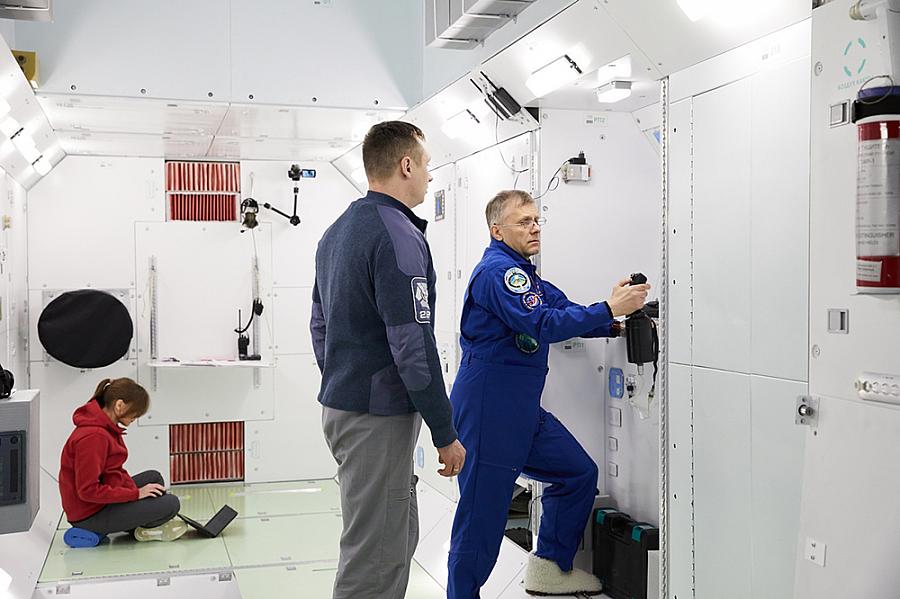
Staff members of the flight test department of RSC Energia (a part of State Corporation Roscosmos) together with representatives of the Institute for Bio-Medical Problems of the Russian Academy of Sciences (IBMP RAS) and Gagarin Cosmonaut Training Center (GCTC) have completed an experiment to simulate the intravehicular activities of the crew in the ergonomic mockup of the Science and Power Module (SPM).
The test team consisted of two crews and a group of specialists, who performed the functions of the MCC. A notional ‘mission plan’ of the crew and the outfitting of the mockup in this experiment were selected in such a manner as to evaluate interactions between the crew, the equipment and the functional zones of the module.
The experiment conducted on April 24 and 26 simulated a work day of a crew of three: they simulated manual docking with a logistics spacecraft, handling of scientific equipment, maintenance and repairs on the module.
In the future, the mockup is to be used for developmental testing of onboard manuals and procedures for this module, as well as of the documentation for its integration into the Russian Segment of the ISS. The assessment of human engineering aspects will be conducted during the next phase of the SPM development, the flight model.
- We have formed the crews of those who took part in the preparations for the experiment: The commander is from GCTC, the engineer is from Energia, and the researcher is from IBMP. This serves as a pattern for the crews of the future, who work most efficiently when everyone performs his or her own function. The results of the experiment conclusively prove that the designers had a competent approach to the development of the module design, and took into account both proposals from cosmonauts and the technical aesthetics issues. As it turned out, there were very few suggestions and criticisms, and those that were will be included in the reports. Being at the phase where we are proceeding to the manufacturing of the flight model, one may safely say that we have implemented a full scope of human engineering support for the SPM, - summarized the results the experiment manager, the head of the Energia flight test department Mark Serov.
Andrei Borisenko, pilot-cosmonaut:
- The task of the crew commander both on the ground and in space is the same: Accomplish every task under the day’s program. Our suggestions will be aimed at improving the work of the crewmembers and the interactions with the MCC. It would be very nice if I get to be lucky enough to have a chance to work onboard this module. I’d very much like to see this module as a part of the Russian Segment of the ISS!
Yevgeny Prokopiev, engineer of the flight test department:
- We worked according to the timeline of typical day. We performed cognitive psychological tests to evaluate the condition of the crew members, visual instrumental observations of Earth and son on. One of our tasks was to literally get into each other's way in order to identify the weak spots in joint activities. For me, as a design engineer, the most interesting aspect was hardware accessibility, its installation and dismantling, cable routing.
Yevgeni Mikrin, General Designer of RSC Energia:
- Such experiments are an integral part of the vehicle development process, they must be carried out in due course. I witnessed the experiment, I watched the crew work, since being the manager I must have a detailed understanding of the project progress at its every phase. That’s the only way to build space hardware!


