


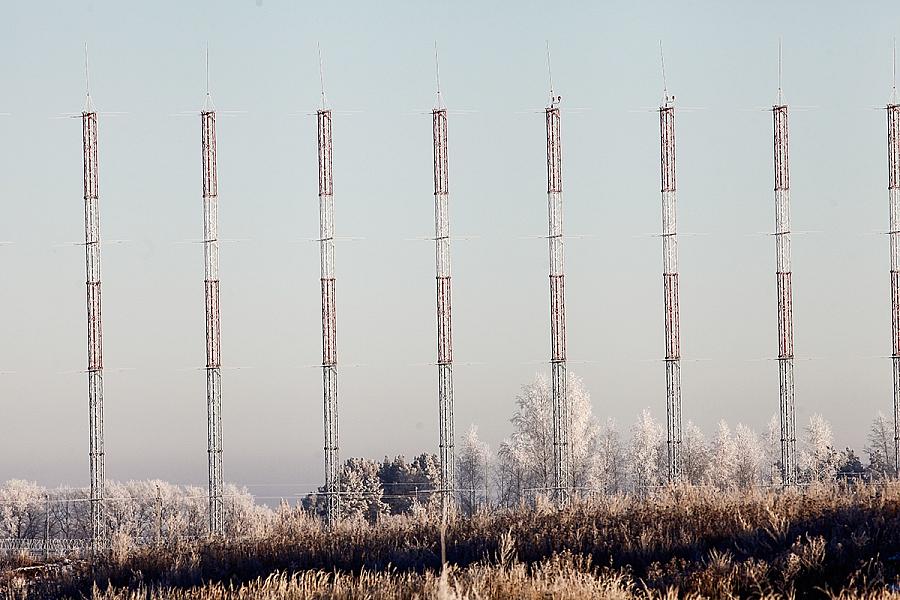
In response to US plans to pull out of the INF Treaty and the active development of its hypersonic technology, Russia is building a network of radar stations best suited to detect missile launches from afar.
Russia is seeking to install Container-type over-the-horizon (OTH) radar stations along its borders. The move will substantially boost Moscow's capabilities to monitor airspace and detect missile launches, particularly in case of hypersonic projectiles.
An OTH radar employs completely different technology, compared with conventional radar installations that only provide "line-of-sight" coverage limited to a range of dozens or hundreds of kilometers at best. OTH systems rely on radio waves bouncing off the ionosphere, Earth's top layer that is heavily ionized by space rays. Radio beams of a specific frequency projected by an OTH transmitting antenna get bounced down high up in the sky and on their way back to the ground can be reflected back by aircraft, ships or missiles. The return signal then travels back to the receiving antennas, again, via the ionosphere. This technique extends coverage to thousands of kilometers.
Russian researchers had to develop new equipment and processing algorithms to compensate for the interference caused by Sun's radiation in the ionosphere. It takes sophisticated mathematical algorithms to isolate relevant targets and, and more so to determine their velocity and direction based on the Doppler shift.
The idea of using radio waves reflected off the ionosphere to detect over-the-horizon targets was originally floated back in the 1940s, but it took some time to quash initial doubts that background noise would be too strong to track faraway objects. Research in this area resumed in the Soviet Union in 1958, after scientists proved that aircraft could be detected at a range of up to 3,000km on a single-hop propagation and ballistic missile launches can be detected at a range of up to 6,000km on a two-hop propagation.


