


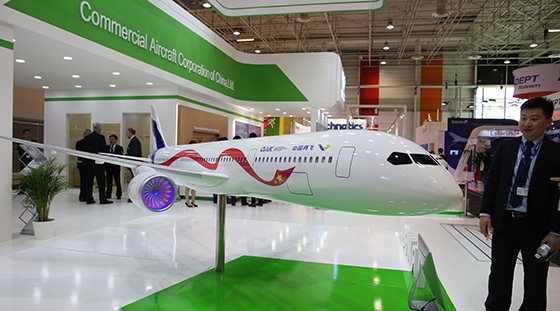
Russia has started developing an engine for a long-haul wide-body airliner and has invited China to take part in this work, International Cooperation and Regional Policy Director at state hi-tech corporation Rostec Viktor Kladov said on Thursday.
‘We have invited the Chinese side for partnership in developing the engine as the time is pressing while the Russian side has launched work on the PD-35 engine. There is a decision by the Russian leadership and the United Engine-Making Corporation has already started work on this promising engine," Kladov said, stressing that a task had been set to start the commercial operation of the Russian-Chinese plane already in 2025.
"I believe that Chinese partners will be glad to join us as soon as this project gets its visible outline," he said.
"This is a big theme and it requires large financial resources," Kladov said, presuming that it would be possible to make this work easier by joint efforts.
"But we’ll be able to do this on our own as well," he added.
In response to a TASS question about how real it would be to mount a PD-35 engine on the wide-body aircraft being developed jointly with China, Kladov said: "This is what we’ll be seeking."
At the initial stage, a foreign-made engine may be installed but eventually there are plans to switch over to the domestically-developed motors, he stressed."We need this engine ourselves and that is why in this case it does not matter whether we develop it jointly or on our own," he said, adding that this was extremely important from the viewpoint of ensuring technological independence of current market leaders in the production of wide-body aircraft.
"If we want to get rid of the technological dependence of third countries, then the engine must be of Russian-Chinese make. We do not rule out both General Electric and Rolls-Royce as partners, especially at the first stage, but the final goal will be to develop a powerful world-class engine of our own make," Kladov said.
"The reality is that no one can guarantee the reliability of engine deliveries in the future - in five or ten years. There is no guarantee that we won’t hear ‘no’ at some stage. We are now living in the conditions of global monopoly. There is Boeing and there is Airbus, which have divided the world market in half. Would they want a third rival to emerge? That is the question," he said.


