


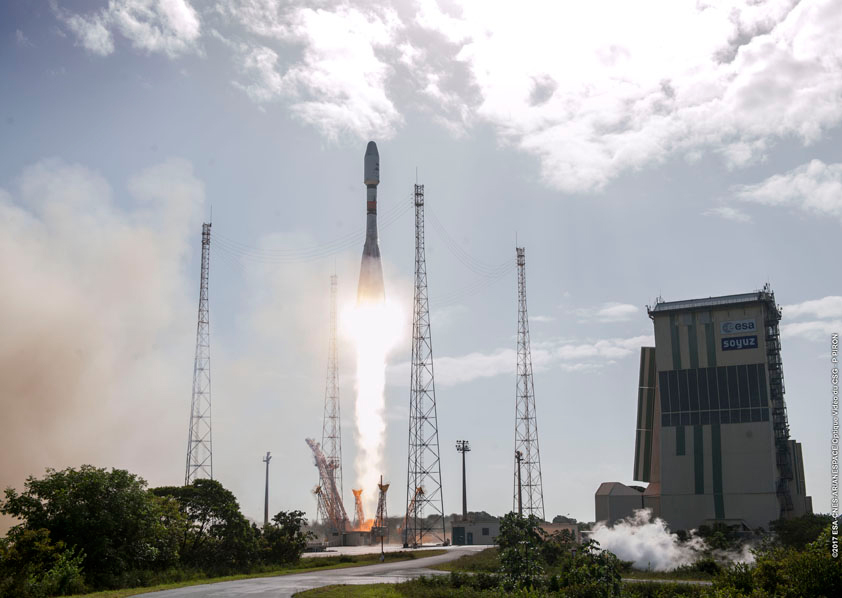
Russian Soyuz launcher and Fregat-M upper stage have orbited the SES-15 telecommunications satellite for European operator SES. Liftoff took place on Thursday, May 18 at 14:54 MT from the Guiana Space Center (CSG), Europe’s Spaceport in French Guiana.
This launch was the fifth of the year for Arianespace, and the second by Soyuz from CSG to geostationary transfer orbit (GTO), as well as the first Arianespace launch carrying a satellite with all-electric propulsion.
SES-15, the first all-electric satellite in the SES fleet, will offer wide beam coverage and the capacity of a high-throughput satellite (HTS). It will provide additional Ku-band wide beams, HTS capacity in Ku-band, along with Ka-band connectivity with gateways.
The satellite will offer services to the booming aeronautical sector, and will also support other traffic-intensive data applications, including governmental services, VSAT networks and maritime communications. SES-15 also carries a wide area augmentation system (WAAS) payload, which will enable the United States Federal Aviation Administration (FAA) to improve the performance of global positioning systems (GPS), by enhancing precision, integrity and availability for the aviation sector.
Flight VS17 is the second launch to this orbit by Soyuz in 2017, following the VS16 launch for Hispasat in January 2017.
Today’s 17th Soyuz launch from CSG was different from previous missions in terms of its duration (5h18m28s) and the targeted elliptical orbit (2,200 km. perigee and 31,300 km. altitude during first apogee). Using the Fregat upper stage, this launch placed SES-15 into a specific geostationary transfer orbit designed to significantly reduce the time needed for the satellite to move itself into its definitive position using electric propulsion. The reduction in deployment time therefore is approximately one month from the estimate of seven to eight months.
With this successful launch, the Soyuz rocket – already the benchmark for telecom and navigation constellations (Globalstar, 03b, Galileo, OneWeb) – clearly shows its versatility and ability to perfectly address the market for electric satellites. It also confirms the availability and versatility of Arianespace’s family of launchers, at the service of all customers.


