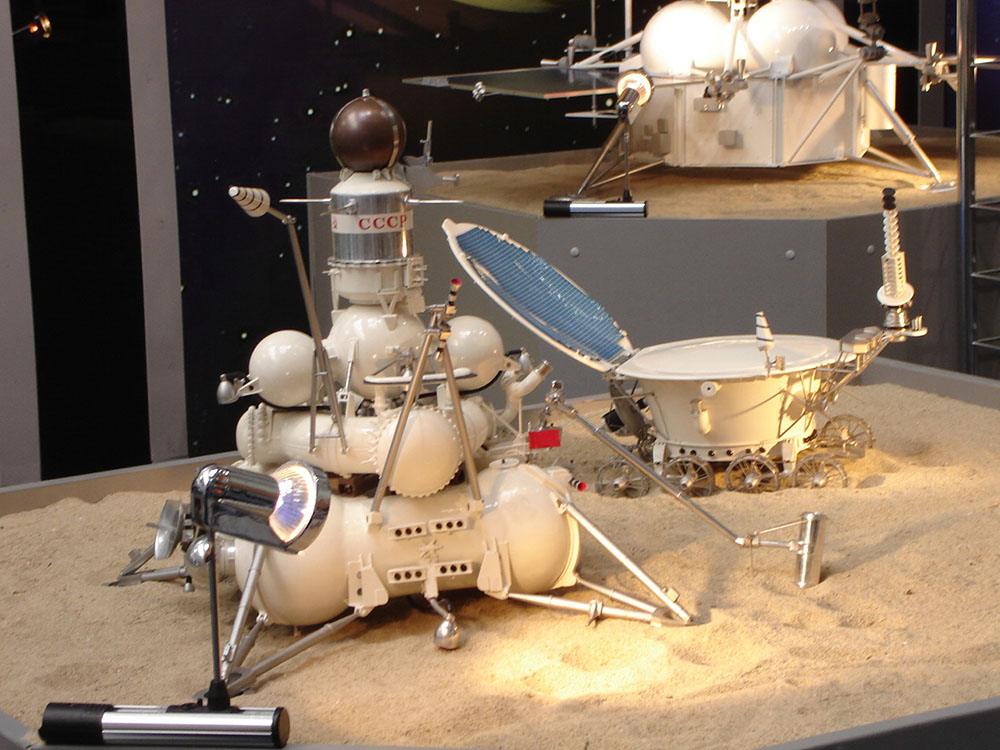
On February 14, 1972 Luna-20 was launched from Baikonur. It is automatic interplanetary station (AIS) which for the first time delivered to the Earth the lunar soil samples taken in an inaccessible continental region of the moon.
The station was injected into the flight trajectory toward the moon by the Proton-K launch vehicle. In four days after the launch AIS was transferred to a circular selenocentric orbit. The soft landing on the Moon’s surface was made on February 21 in the mountainous region between Mare Fecundidatis and Mare Crisium.
During the mission the lunar soil drilling and sampling were provided, then the samples were delivered to the Earth in a sealed container of the return vehicle.
Luna-20 consisted of a lander with a draghead and the Moon-Earth space rocket with the return vehicle. The AIS mass when landing on the lunar surface was 1880 kg. The lander was an independent multi-purpose rocket stage with the liquid rocket engine, propellant tank system, instrument compartments and shock struts for landing on the lunar surface.