


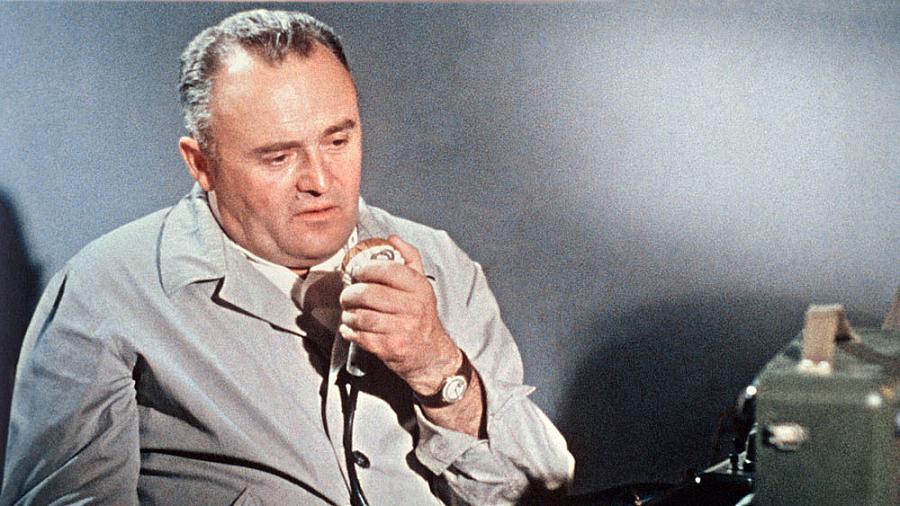
January 12, marks the 110th anniversary of an outstanding designer of rocket and space hardware, the founder and the first head of OKB-1 (now RSC Energia) Sergei Pavlovich Korolev.
Korolev was born on January 12, 1907, in Zhitomir (Ukraine). He graduated from Odessa Building Trades School No.1, studied at Kiev Polytechnic Institute and at Moscow Bauman Higher Technical School. After that – an engineering job, appointments, persecution and the comeback as a designer.
A scientist of world renown, the man who made spaceflight a reality by putting into practice Tsiolkovsky’s theories, Korolev will forever remain the first and chief designer.
He organized and headed work in the post-war USSR on the development of the nuclear missile shield, the first ballistic missiles and systems on their basis. Under Korolev’s belt are the first space rocket R-7, the world’s first artificial Earth satellite, the first man in space, first scientific satellites, interplanetary probes for exploration of the Moon, Mars, Venus, etc. Sergei Korolev directed development of communications satellites Molniya-1 and surveillance satellites Zenit, manned spacecraft Vostok and Voskhod. While he was in charge, the USSR launched lunar programs, began development of manned spacecraft Soyuz, refueling cargo spacecraft, space tugs and many other things. Korolev initiated studies of manned complexes for missions in low-Earth orbit and into deep space, including missions to Mars.
Most of Korolev’s projects are referred to as “firsts”, and this is hardly a surprise. He combined the qualities of a visionary and a realist, of a great organizer and a talented designer. His brilliant talent, amazing energy and zest for life, ability to take risks and hold his own made Sergei Korolev a true hero of his time.
Remaining for 20 years at the helm of OKB-1, which he had founded, Korolev established a school of thought in the field of development and application of a huge number of rocket and space systems. OKB-1, traditionally referred to as “Korolev’s Firm”, became the springboard for establishing in our country a powerful rocket and space industry, comprising hundreds of companies. In most of ambitious space projects of today one can detect an echo of Korolev’s ideas. He knew how to look beyond horizon, and at the dawn of space exploration he outlined the paths, which are followed by today’s spaceflight.
He authored and co-authored more than 250 scientific papers, articles and inventions. Twice Hero of Socialist Labor (1956, 1961). Winner of the Lenin Prize (1957). He was awarded the orders of the Badge of Honor (1945), of Lenin (1956, 1961), medals For Valiant Labor during Great Patriotic War of 1941-1945 (1945), In Commemoration of the 800th Anniversary of Moscow (1948), K.E. Tsiolkovsky Gold Medal of the USSR Academy of Sciences (1958).
Monuments, busts, memorial plaques, bas-reliefs and other objects commemorating Korolev are installed in a number of towns in Russia and countries of the former USSR. His name was given to the town of science Korolev (formerly Kaliningrad) in the Moscow region, to RSC Energia, Samara State Aerospace University, sea-going research vessels, a crater on the Moon, asteroid No. 1855 Korolev, a star 5 No. 000001 in the constellation of Capricorn “Designer Korolev”, mountain peaks, streets in various cities, museums, etc. Prizes, scholarships and medals named after Korolev have been established.


