


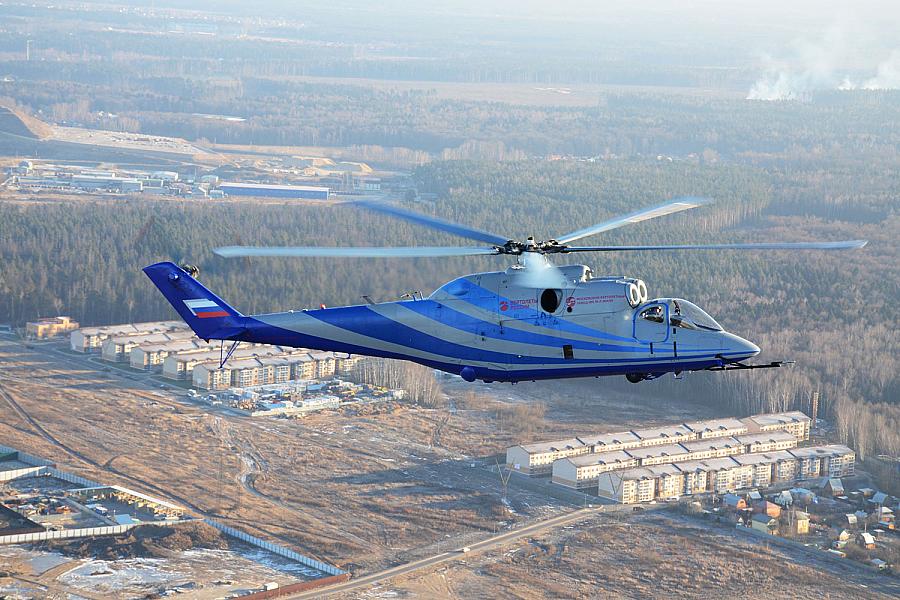
The flying laboratory for the future high-speed helicopter (PSV) has completed its first flight in Russia. The crew praised the aircraft’s good stability and maneuverability, according to the press service of Russian Helicopters.
The PSV flying laboratory is an experimental aircraft based at the Mi-24 helicopter. It is believed that the aerodynamic design of this model makes it the best for carrying out high-speed flight. Some elements of the flying laboratory’s fuselage have been retooled to significantly reduce air resistance and improve the aerodynamics of the helicopter when flying at high speeds.
Following the first flight, the crew noted the good stability and maneuverability of the helicopter, as well as its high dynamic performance and the normal operation of all systems and equipment.
All of the information collected during the flight experiments will help develop new helicopter models. As noted in a press statement from the holding, the resulting technological advancements can also be used to modernize existing helicopters.
In May 2015, it was revealed that Russian Helicopters’ work on developing mid-range commercial helicopters. The holding plans to spend more than RUB 7 billion on this project.
In September of last year, Viktor Bondarev, head of Russia’s Aerospace Forces, said that the future high-speed helicopter, expected to be mass-produced beginning in 2022, will be able to reach speeds of 450 kilometers per hour.
KRET developed the onboard equipment for the PSV based on the “glass cockpit” principle. KRET presented it for the first time at HeliRussia-2014, the international exhibition for the helicopter industry.
The new system is based on the concept of integrated modular avionics, which will improve safety, reduce the cost of the aircraft’s manufacturing, and enhance the ability to integrate system units with all helicopter models, not just those of the PSV.
The system is built using the "glass cockpit” principle. It uses a large-format, high-resolution multifunction LCD screens. Thus, it facilitates the work of pilots by familiarizing them with flight, aerobatic, weather navigation, and other necessary information. KRET equipment enables piloting in all conditions of visibility.


