


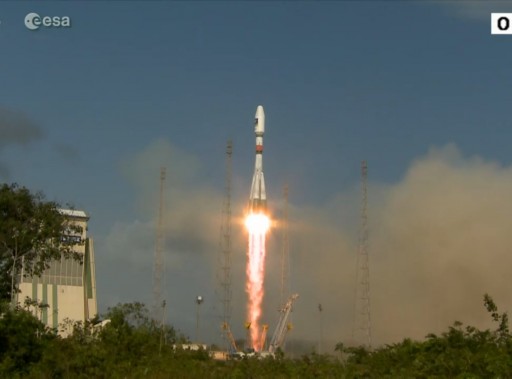
Russia’s Soyuz workhorse launch vehicle blasted off from its tropical launch site in French Guiana on Thursday at 11:51 UTC, embarking on a mission to deliver the 11th and 12th satellites in the Galileo satellite navigation system to orbit, Spaceflight101 portal reported,
Aiming for a Medium Earth Orbit, Soyuz swung to the north east and provided the satellites with a smooth nine-and-a-half-minute ride into a sub-orbital trajectory from where the Fregat Upper Stage assumed control of the flight. Fregat completed its first lengthy main engine burn immediately after separation and then entered a coast of three hours and 15 minutes to set up for a critical circularization maneuver. Spacecraft separation into an orbit of 23,222 Kilometers is planned three hours and 48 minutes after liftoff, 15:39 UTC.
Managed by the European Commission, Galileo is being built at Europe’s civilian counterpart to the military-operated Global Positioning System of the United States, the Russian Glonass and the Chinese Beidou systems. To consist of a total of 30 satellites orbiting in three planes, Galileo is set to continue deployment over the next several years using the Soyuz rocket to launch two satellites at a time and Ariane 5 carrying a group of four satellites per launch.


