


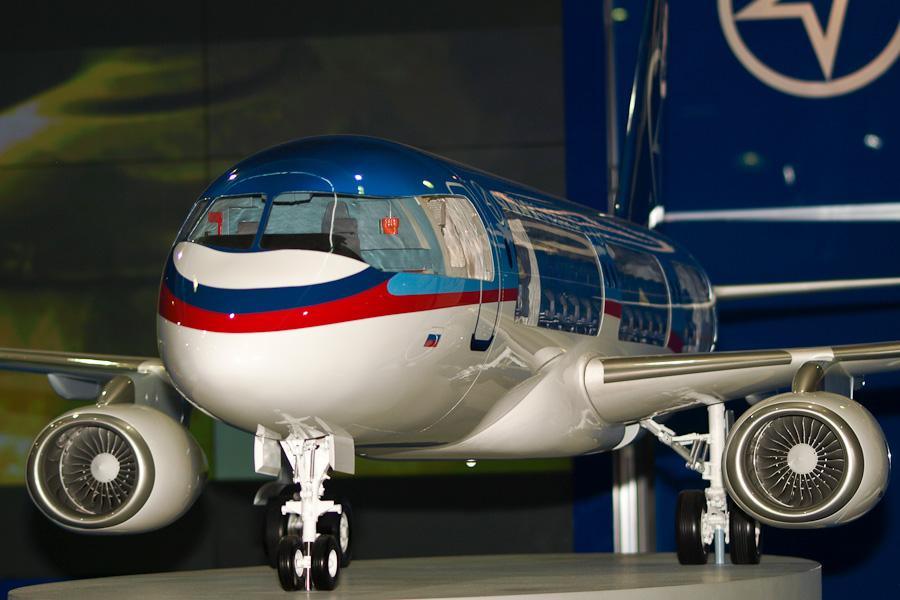
European Aviation Safety Agency (EASA) has issued A-176 type certificate for Sukhoi Superjet 100 (RRJ-95B). The certificate confirms that Sukhoi Civil Aircraft (SCA) has demonstrated the conformity of SSJ100 to the active EASA requirements on airworthiness and environmental impact. EASA certificate allows European airlines and other countries, which use EASA guidelines as a standard, to acquire and operate SSJ100 (RRJ-95B) aircraft. This is the key milestone in terms of supporting the reputation of Sukhoi Superjet 100, which is the first Russian passenger liner, certified in accordance with CS-25 EASA aviation regulations, SCA’s press-service reports. AEX.ru
The ceremony of EASA type certificate presentation will take place at the headquarters of Interstate Aviation Committee in Moscow on February 24th 2012.
The acquisition of EASA certificate by validating the Aviation Registry of Interstate Aviation Committee (AR IAC) certificate was the result of completion of a massive certification program, carried out by EASA, AR IAC and SCA in cooperation with certification centers, Alenia Aermacchi (ex-Alenia Aeronautica) and major suppliers of equipment and aircraft systems.
The validation process has been started after the submission of request for AR IAC certification in 2004 and has been carried out in parallel with AR IAC certification with four different phases: Review, Harmonization of certification programs, Conformity assessment and elaboration of the final report. European aviation experts have studied the aircraft, analyzed its performance and then received the approval of the jet’s operational capabilities and safety. The validation process has approved the conformity of SSJ100 to the strict European aviation regulations and as a result the EASA certificate has been issued.
Owing to the vast experience and self sacrificing work of multi-cultural group of SCA’s specialists, the EASA certificate has been acquired in a year’s time after the completion of AR IAC certification.
The European validation program included some special ground and flight tests. In particular, EASA pilots have performed sessions on “Electronic Bird” integrated rig and taken part in 45 certification flights with a total duration of about 70 hours in order to be convinced in safety and appropriate behavior of the jet in any situation. The ground tests included loading the pressure cabin with limiting pressure, assessment of functionality of cockpit desks after a bird striking the area above canopy, imitation of part of the tire hitting the tank cap and confirming the fire-resistance of composite flaps. 84 CRI paragraphs and 60 CAI ones have been analyzed, justified and harmonized in the network of 10 work teams. More than 500 questions received from the aviation authorities have been solved in time and in the proper way.
«We have done a great joint work and we sincerely thank our colleagues from EASA and AR IAC for their support. The European certification is one of the key milestones in the network of world acknowledgement of our aircraft, which will open new prospects for Sukhoi Superjet 100 at the global market », – Vladimir Prisyazhnuk, president of SCA, said.
The European certification becomes even more important taking into account the international essence of the Sukhoi Superjet 100 project, which is based on the growing potential of Russian aircraft industry coupled with strategic partnership with Alenia Aermacchi, reliable technical support provided by Superjet International and the authority of Snecma, which is one of the key participants of PowerJet SaM146 engine program.
The list of foreign and Russian suppliers for Sukhoi Superjet 100 program is enormous. With that, we have to admit the great contribution of the major suppliers – Aerospace Thales, Liebherr, Messier-Bugatti-Dowty, Hamilton-Sundstrand and B/E Aviation, which have brought many advanced technologies into our project.
It is clear that such a wide integration of cultures and processes has caused challenges, but it has also become the trademark of Sukhoi Superjet 100 and now we are confident that SCA and SJI will be able to deliver the advanced and efficient aircraft to their customers all over the world.


