


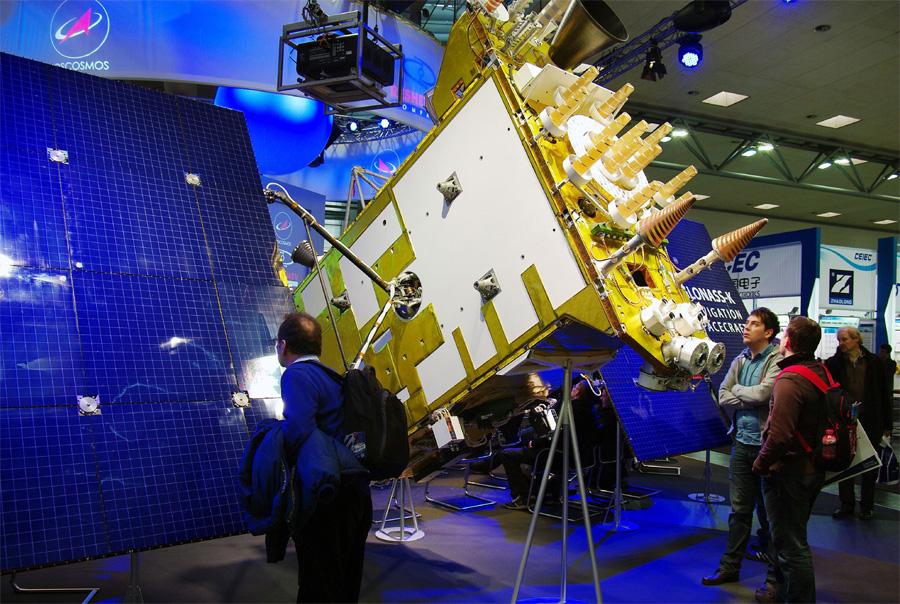
According to CEO of Russian Space Systems (developer GLONASS), Yuri Urlichich, new Russian navigational Glonass-K satellites are highly competitive with the American GPS by their technical features, RIA Novosti reports.
"Glonass-K satellites are highly competitive with the American ones, but Glonass-M satellites are really yielding at present", - said Urlichich.
According to him, Russian Cospas-Sarsat system’s sensors installed on the American satellites of GPS system are not working at present, but the system will start operating with the launch of new Russian satellites Glonass-K.
GLONASS is a radio-based satellite navigation system, providing real time position and velocity determination for military and civilian users. GLONASS operated for the Russian government by the Russian Space Forces. It is an alternative and complement to the United States' Global Positioning System (GPS), the Chinese Compass navigation system, and the planned Galileo positioning system of the European Union (EU) and Indian Regional Navigational Satellite System of India.
Cospas-Sarsat is an international satellite-based search and rescue (SAR) distress alert detection and information distribution system, established by Canada, France, the United States, and the former Soviet Union in 1979. Over the years many countries have joined the project, either as providers of ground segments or as user states. As of 2010 26 countries (Algeria, Argentina, Australia, Brazil, Chile, China, Greece, India, Indonesia, Italy, Japan, Korea, New Zealand, Nigeria, Norway, Pakistan, Peru, Saudi Arabia, Singapore, South Africa, Spain, Thailand, Turkey, UAE, UK, Vietnam) and two organizations (ITDC of Chinese Taipei and Hong Kong, China) are providers of ground segments, while nine countries are user states (Cyprus, Denmark, Germany, Madagascar, Netherlands, Poland, Sweden, Switzerland, Tunisia). Cospas-Sarsat is based in Montreal, Quebec, Canada, and is headed by Daniel Levesque of France.


