


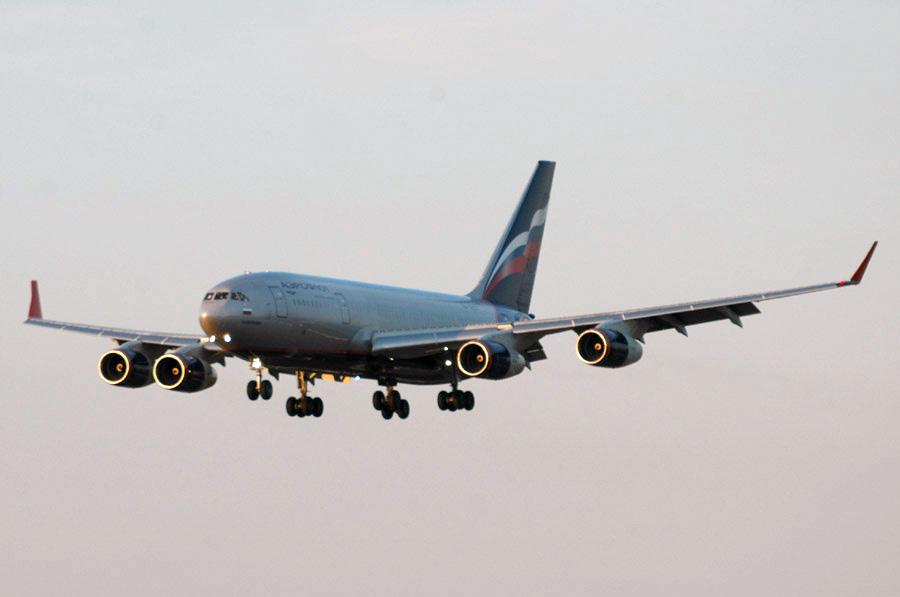
Central AeroHydroDynamics Institute (TsAGI) in Zhukovsky near Moscow has completed fatigue testing on the Ilyushin Il-96-300 airframe for 40,000 flight cycles, which is twice the original design target for the airplane, at 20,000 flight cycles.
The scientists are now processing information on cracks development. The work is being carried out in the view of further fatigue testing, to prove the Il-96’s airframe can withstand 60,000 flight cycles.
A total of 5,000 sensors are placed in the zones with purposely inflicted damage, for research purposes. Cracks development is monitored by computer-aided system processing data coming from crack sensors. The testing is being performed on a purposely built test rig that allows to emulate various loadings that take place in real flights.
TsAGI’s fatigue specialists make use of a multi-channel system for wing loading that employs a movable platform. The platform changes position synchronously with deformation of the wing, corresponding to on-ground and in-flight modes. Loading is emulated with help of 150 electric hydraulic channels.
The project is aimed at working out checks and methods that would enable Il-96 aircraft operators and maintenance centers to assess condition of a particular airframe and make decisions for its further use on flight operations.


