


Last year, the volume of passenger traffic came to nearly three thousand passengers carried. During the first four months of 2015, almost a hundred thousand passengers were carried. This compares to figures for the whole of previous years (106,091 passengers in 2011 and 113,483 in 2012).
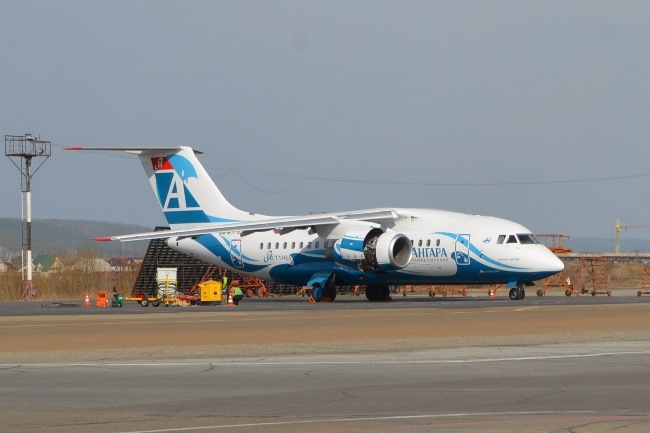
Today, the airline’s fleet comprises thirty three aircraft, including some modern types such as the Antonov An-148E and Mil Mi-8MTV. These allow Angara not only to work successfully in its traditional markets, but also win lucrative contracts for international projects.
According to the official statistics from Russia’s civil aviation authority (Rosaviatsiya), in the first four months of 2015, Angara’s traffic rose by 28.8% (to the same period of the previous year) if measured in passenger heads, and by 46% if measured in passenger kilometers (pkm).
These results are all the more remarkable when viewed in the background of overall situation in the country and its air transportation system. Russia’s air transportation industry had negative dynamics in the first four months of 2015. Passenger traffic measured in pkm went down by 8.9%, while passenger numbers reduced by 2%. In this sad background, Angara –– demonstrates a 46% pkm and a 28.8% pax rise.
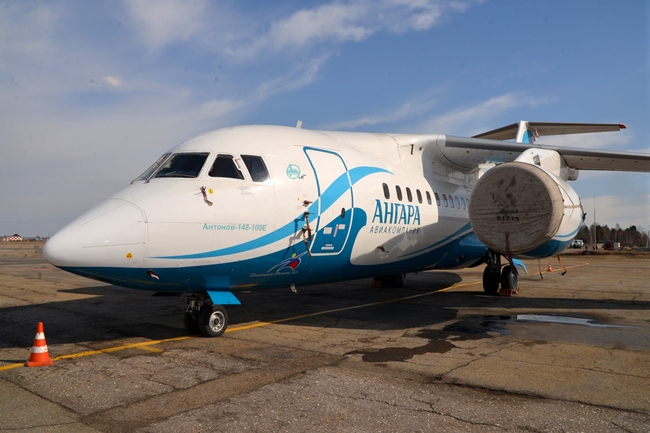
Unlike majority of other carriers, Angara does not operate imported aircraft. After the Rouble’s exchange rates to US$ and Euro fell sharply last year, Airbuses, Boeings and Bombardiers suddenly turned from money makers to loss generators. This is not the case with the Ukrainian-designed, Russian-made An-148-100E that Angara operates on financial lease terms, since the rents are paid in the local currency.
Angara is now famous for being the only Russian commercial operator of the An-148 regional jet with 75 seats. Three aircraft were provided by Ilyushin Finance Co. in 2012 and two more by Sberbank Leasing in October-December 2014, all with a single-class cabin seating at 32in abreast.
Angara is the biggest service provider in the region on Antonov aircraft. It has a solid base at Irkutsk city airport, with heated hangars for heavy and line maintenance, repair, painting and interior refurbishment. Non-recurring costs of mastering An-148 came to about Rouble 0.4-0.5 billion, chiefly on ground infrastructure, mastering maintenance procedures, personnel qualification and training. The type’s operations are profitable, but break-even point for initial investment is yet to be achieved.
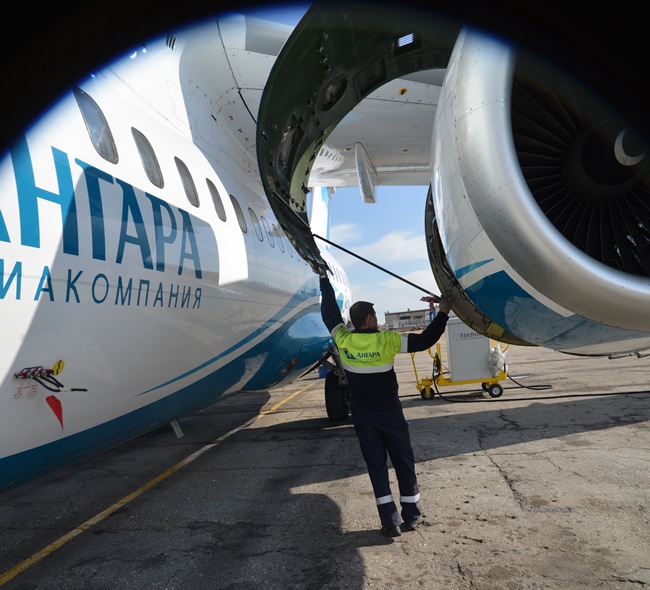
Monthly utilization has grown from 120 flight hours per airframe in the first years to 155 in the fall of 2013 and about 200 in 2015. This is comparatively low, but Angara’s strategy is not about records (“excessive flight hours might lead to problems”, as an Angara spokesman puts it), but careful economic planning.
The carrier has been leveraging on “points of growth” in the Siberian economics. Angara is a branch company of East Land holding whose main business is tourism, primarily serving foreign nationals coming to see the lake of Baikal and the surroundings, and the locals spending their holidays in warmer climates.
With the An-148 inaction, the traffic doubled, from just over one thousand passengers in 2011-2012 up to 228.5k in 2013 and 229.5k in 2014. With a 33-strong fleet, Angara performs scheduled flights, regular and one-off charters. The An-148-100E with range up to 4,400km [2,375nm] performs mostly 2-5 hour flights, including scheduled services from Irkutsk to seven destinations, and from Novosibirsk to six. Besides, it does regular charters to Black Sea resorts in Sochi and Kransnodar, which are increasingly popular with East Siberians.

Shorter routes, including eight out of Irkutsk, are served by six 48-seat An-24 and three 43-seat An-26-100 turboprops. Three city pairs on An-148s and three on An-24s are subsidized by the local administration.
Four An-2 biplanes are used for aerial works, while fifteen Mil Mi-8T/P/MTV 24-28 seat helicopters carry passengers, tourists and shift workers. This mix of types permits Angara to win tenders of tourist and fossil fuel companies operating in Eastern Siberia.
There is a growing need to replace the ageing An-24 and Mi-8T/P, but mostly likely these will fly until lifetime resources are used up completely. Angara has considered several western types, but careful economic analysis rules them out, as earnings in Roubles don’t match rentals in the hard currency. The carrier increasingly looks to Russian and Chinese suppliers for more viable offerings.
“Our strategy is to go after the oil and gas”, Angara says. Previously, its client base was mainly of medium oil companies. Now, with good financial results of 2013-2014 and multi-type fleet available, Angara wins one tender after another with fossil fuel giants. They work on exploration of the big oil&gas fields north of Baikal, from where the oil and gas will be pumped into China under the big deals signed in 2014-2015.

Last year, Angara won approval for international passenger services. This opened the way for the process of obtaining licenses to operate certain scheduled and regular charter routes. Today, the airline holds all necessary permissions for a dozen of routes linking Irkutsk and other Russian cities with destinations in Mongolia, China and other neighboring countries. First flight to Mongolian capital of Ulan-Bator was carried out on October 20, 2014, and is now being performed under agreement with the local carrier MIAT.
Last month (May 2015), Angara opened ticket sales for Novosibisk – Lenkoran service, linking the largest Siberian city with a destination in Azerbaijan. Revenue services are to commence in June 2015. This is the first scheduled international service for the airline.
More regular passenger services are to be opened in the second half of 2015 and 2016, mostly in the interests of fossil fuel giants and tourist agencies. Angara plans to open An-148 services to ten destinations in China, including Beijing, Shanghai, Shenyang, Harbin and Urumqi. Next in line are Tokyo and Seoul.


